Nowadays, it’s common to receive a diagnosis of a mental disorder, especially for children and young adults. In the past, diagnoses were rare and mostly used to describe more severe forms of mental illness and suffering.
There are probably several reasons why diagnoses are given more liberally today. Partly, we’ve become better at recognizing and detecting mental health challenges. Partly, many of us are more chronically stressed, not least because of the constant flow of information and the lack of calm and concentration our brains are exposed to. And often, sadly, diagnoses are the only way to access help through public services or health insurance.
Diagnoses can be helpful in treatment planning. When a relevant treatment exists, a diagnosis can point to the right one. And according to a young psychiatrist I spoke with last week, many people also feel seen and relieved to receive an explanation that lifts the burden of responsibility. But he said he prefers to avoid diagnosing unless absolutely necessary — and would rather support people’s healing and transformation through psychotherapy, if that’s what they want.
The Norwegian writer and psychologist Arnhild Lauveng, who fought her way through extreme mental suffering and psychiatric stigmatization, felt imprisoned by her diagnosis. She, too, advocates for therapy and other mental health support that meets the individual human being — not the label.
When I was a young woman, I was one of those ambitious and very sensitive young people. Today, I would probably have been diagnosed with an anxiety disorder. Several highly educated and experienced professionals wanted to diagnose me at the time, but those labels neither helped me nor described me very well.
So I let them go — and chose instead to grow through therapy, art, closeness with others, and, not least, time in nature.
At the same time, I’ve always been very drawn to personality tests and have visited many clairvoyants — mostly in my search for my purpose in life, my soul nature, my calling.
Many of the people who come to my courses or my clinic feel the same. They are looking for their calling or a vision for a meaningful life. And I believe that many of us feel a deep need to find a beautiful and rewarding purpose — because it’s only from that place that we can help our suffering world.
Over the years, I’ve learned that a life purpose is not something fixed. It unfolds gradually under the right conditions — just like the acorn that becomes an oak tree without self-doubt, therapy, or personality tests, as James Hillman describes so beautifully.
So how do we create the conditions that allow us to grow, so our inner acorn can become the oak?
In my world, it rarely begins with diagnoses.
For me, it’s about coming into contact with yourself — and the nature of your soul — in a nourishing and creative way.
In The Art of Self-Healing cards, which have just been released by Wonderland Publishing and are now sold worldwide, there is an exercise for exploring your calling. You’re welcome to try it here, for free:
EXERCISE: Listen for Your Calling
Put on Chopin’s Nocturne, Opus 9, No. 2 in E-flat major (you can find many beautiful versions online).
While listening — or while listening to any piece of music that calls you — reflect on this:
What is calling you now?
Write freely.
If you prefer more structure, you can try this:
-
Draw three overlapping circles.
-
In the first circle, write a few words about the activities or tasks that awaken your joy, curiosity, and aliveness.
-
In the second circle, write about what you believe needs to be changed or improved in the world.
What frustrates you? Where do you see a real and urgent need for support? What could genuinely help? -
In the third circle, write what you know you’re good at — things you feel skilled at, and things others often compliment you for.
-
In the center — the rounded triangle (the Reuleaux Triangle) — write the themes that repeat in all three areas.
-
Look at your diagram.
What does it tell you about what you love to do, what the world needs, and what you’re good at?
What might be your first small step toward your calling?
If you feel drawn to explore your purpose, feel free to write to me. I am developing some new course ideas and would love to hear whether this speaks to you.
Thank you for reading my reflections — I’m grateful that you’re here.
With love and creativity,
Karin
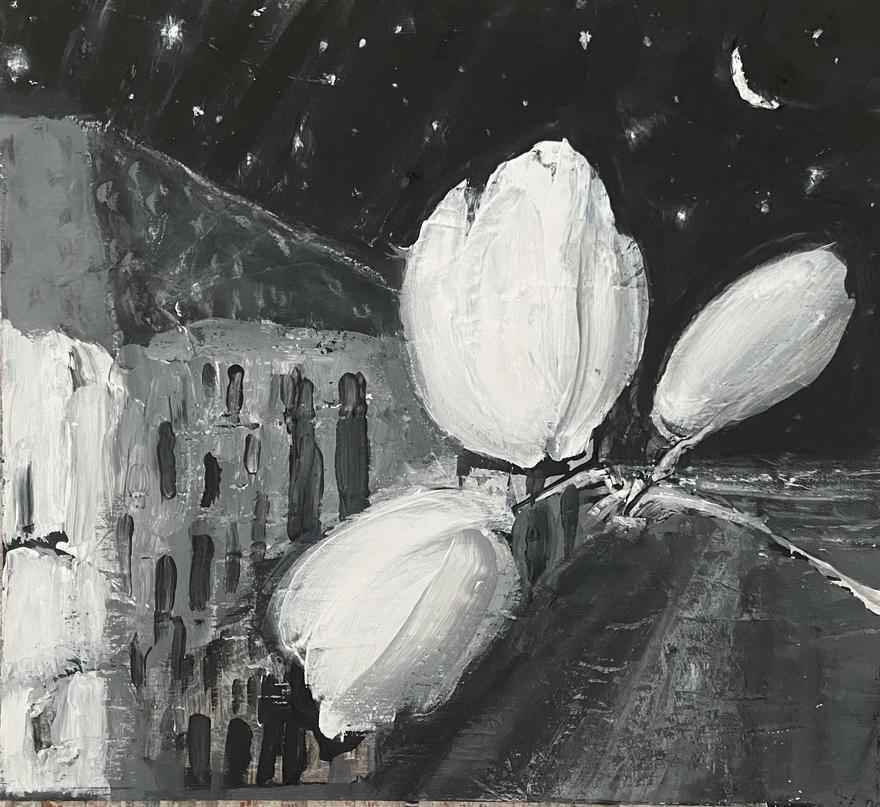
Art on the blog by Karin von Daler © can be purchased in the webshop. You are welcome to share the blog.








Comments